global@hmeonline.com
Mon to Fri 09:00 – 17:30






Amazon's banning operation continues, and cross-border e-commerce practitioners in Shenzhen are in crisis.
"The beauty of cross-border e-commerce last year will be as miserable this year." In June this year, Wang Wei (a pseudonym) told a reporter from Jiemian News Greater Bay Area Channel, "It feels like half of Shenzhen's Amazons have been blocked." This is the largest title he has ever seen in his career.
Wang Wei is a cross-border e-commerce practitioner in Shenzhen. He is responsible for the overseas operation and promotion of the company's brand. He has 5 years of experience. In the recent wave of bans, his company's Amazon account was not spared.
It is understood that this wave of Amazon bans is mainly concentrated on sellers in Shenzhen, starting from the top sellers (big sellers), and the performance scale is all tens of billions, and then the second echelon, the scale of several billions, is also closed. More small and medium sellers will be blocked.
The industry even described this as "a huge shock in the industry that has not been seen in ten years."
Big sellers in Shenzhen have been blocked three times for "swiping orders"
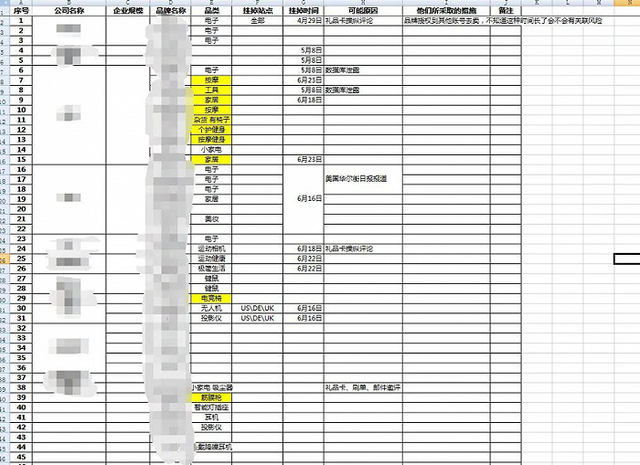
Since the end of April, the main brands of Shenzhen's big sellers, such as Patoxon, Aoji, Tongtuo, Zebao, Apeman Technology, and Wantuo Tech, have been blocked, and they have not been restored so far. According to incomplete statistics, there are currently more than a dozen banned big sellers, involving more than 40 brands, most of which are 3C products.
A banned "list" circulating in the cross-border circle
Wang Wei bluntly pointed out that the reason for the title is "swiping orders", which is already an open secret of the industry. "How many people don't pay orders when doing Amazon?"
The so-called "swiping orders" generally refers to the behavior of platform sellers providing relevant fees to help designated online store sellers to purchase goods to increase sales and credit, and to fill in false positive reviews. "Swiping orders" has formed a mature industrial chain at home and abroad.
There is even such a saying in the industry: you may die if you swipe orders, but you can only wait to die if you don’t. Many sellers took the risk because of this.
In May of this year, a cybersecurity expert named Safety Detectives announced an open AWS Elastic Search database, in which the data is related to fake review organizations on Amazon. Among them, more than 13 million direct exchanges between suppliers and customers show that, These customers are willing to provide false reviews in exchange for free products.
On June 16, an announcement issued by Xinghui on major matters of its subsidiaries is worth noting. The announcement stated that "some of the stores involved in the three brands of RAVPower, Taotronics, and VAVA under the subsidiary Shenzhen Zebao Innovation Technology Co., Ltd. were suspended on the Amazon platform on June 16, 2021."
The announcement showed that after investigation, the reason for the suspension of sales may be that some products were given gift cards, suspected of violating Amazon platform rules.
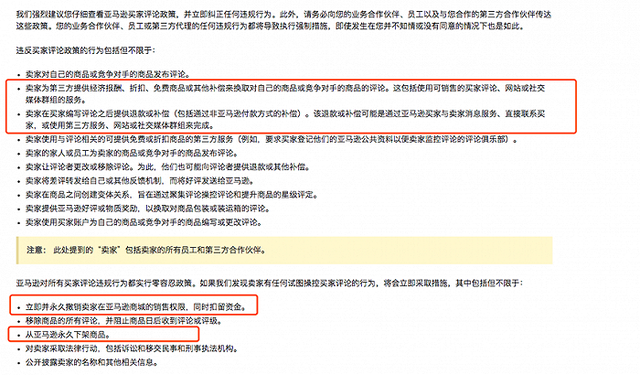
Amazon platform rules
Despite the announcement of clear rules, Amazon's mechanism is a bit like a black box. It is difficult for sellers to understand what behavior and when will trigger the bottom line of the platform. Therefore, the cycle of scalping orders and being blocked can also be seen as a mutual trial between sellers and platforms.
Amazon's attitude is getting more and more determined
In 2020, the cross-border e-commerce fires will stimulate many people to flood in crazily this year. Sky Eye Check shows that there are currently more than 600,000 cross-border e-commerce-related companies in my country, and more than 42,000 cross-border e-commerce-related companies have been added this year.
At the same time, capital poured in. According to the big data of the NetEconomics Agency "Dianshubao", from January to May 2021, a total of more than 20 cross-border e-commerce platforms and service providers have received capital favor, with a total financing amount of more than 10 billion yuan.
Some sellers use "swiping orders" to improve the ranking of products on Amazon. However, because of false reviews and real products, they often do not match. The "fake comments" on the Amazon platform have aroused global media attention. Amazon is worried that its reputation will be affected, so this year's attitude is unusually tough.
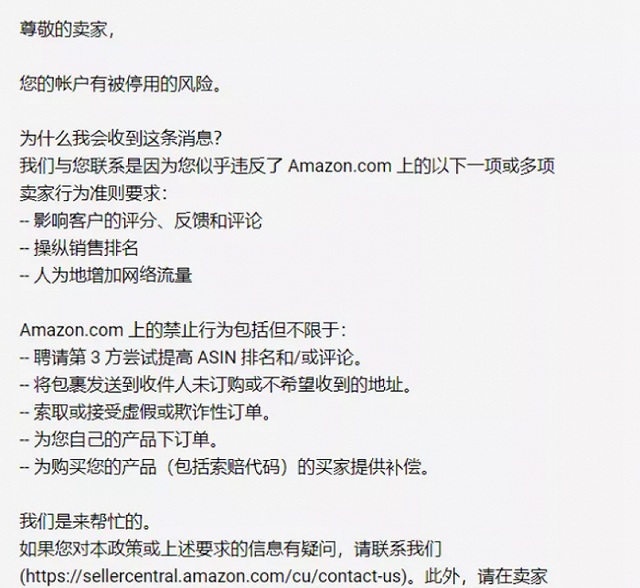
Many sellers are gearing up for a big fight on Amazon this year, but before they taste the sweetness, they first received Amazon's evaluation warning letter.
Amazon warning letter
"In the past, Amazon may have opened its eyes and closed its eyes. This year, it is really not showing any affection." Wang Wei said.
In fact, for major domestic and foreign e-commerce platforms, "swiping orders" is strictly prohibited.
On May 20, Amazon officially released the "Letter to All Amazon Sellers" in response to the "banned" incident. It stated that the platform policy clearly requires sellers not to abuse comments, and for this reason some sellers’ sales rights have been suspended; regardless of the seller’s business scale or location, the platform’s rules and policies treat all sellers equally.
On June 16, Amazon released another open letter "Creating a Trusted Customer Review Experience." Amazon said in the letter that the platform has invested a lot of resources to prevent false or rewarding reviews from appearing in the mall.
"In 2020, we have blocked more than 200 million suspected false reviews before customers saw them, and more than 99% of them were discovered and removed by our active monitoring. We will also prevent accounts that posted false reviews from continuing to submit comments. At the same time, measures are taken against seller accounts that obtain commercial benefits through false reviews.” Prior to Prime Day, Amazon once again responded to the “swipe order” storm.
Some investors believe that, to a certain extent, merchants’ order-swiping behavior can be understood, especially in the early stage of new development, the principles of order-swiping and reviewing are similar to those of domestic buying rankings. However, when the products stand firm, the company still has large-scale orders after it grows, which is tantamount to drinking poison to quench thirst.
Amazon's approach to cracking down on violations of platform rules is becoming more and more determined, which may also be related to pressure from relevant regulatory authorities.
On June 25, the British Competition and Markets Authority (CMA) issued an announcement stating that it had launched a formal investigation into Amazon and Google because of concerns that these two technology giants would not be effective in cracking down on false comments on their websites.
CMA CEO Andrea Coscelli said: "We are concerned that millions of online shoppers may be misled by false reviews and then spend money based on these recommendations."
"Similarly, if some companies falsify 5-star reviews in order to highlight their products or services, and the law-abiding company loses, that would be unfair."
Appeals, layoffs, selling accounts, changing brands... How do sellers deal with the crisis of title suspension?
Once Amazon imposes a penalty on the seller, it means that the seller's store or brand is blocked, and the funds and goods of the account will be frozen by Amazon.
According to Yien.com, the amount of funds deducted in the past month is about 20-30 billion yuan, and it is estimated that all sellers’ funds may exceed 100 billion yuan.
The possibility of recovering after the "title" is almost zero, which is an unbearable pain for the seller, ranging from a serious injury to a serious injury to a direct sentence of "death penalty".
According to Jiemian News, a company in Tianan Cloud Valley, Shenzhen, after its Amazon account was blocked, withdrew the 150 million that it had raised, and the company directly declared bankruptcy. At the same time, some brand sellers are starting to lay off employees, and the demand for cross-border talents has cooled.
According to the Shenzhen Cross-Border E-Commerce Association, many big sellers involved have set up emergency teams and hired lawyers to communicate with the Amazon platform to actively coordinate and appeal.
This wave of account bans caused panic in the Shenzhen cross-border circle, and some sellers simply chose to "sell accounts" to withdraw from the Amazon platform. And some sellers will continue to stay on Amazon. When their brands are blocked, they will switch to another brand and sell the original products, saving themselves in this way, such as Paterson.
In addition, because many of this batch of titles are related to "small cards", for a while, many sellers began to collect small cards collectively. The current job of all overseas warehouses is almost to pick up cards.
In the face of the sudden title crisis, sellers have paid a painful price, which is nothing more than an interpretation of one of the most basic principles of platform survival, that is, compliance operations. On the other hand, this incident also implies that cross-border e-commerce players, the greater the seller's dependence on the platform, the greater the risk of uncertainty.